Friday, April 13, 2007

Difference in comparison.

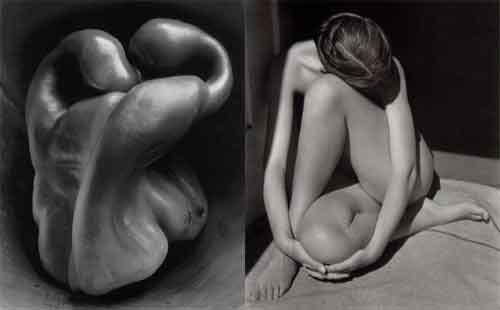
Alright, we all know the Weston Pepper resembles a nude, so what was my point?

The first thing I pulled from comparing it to an actual nude was that it actually started to look like a pepper again. I needed to remember how the Pepper resembled a nude before that view of it would come back to me. It was as if it was a pepper again once an association was actually made with a naked human form.

So, let's see of the opposite is true:


Click the pictures to seem them uncut.

Does the nude exude nudeness or does the pepper exude pepperness? This isn't an altogether irrelevant discussion. We're dealing with a mimicry in its natural and mimicking context. It may be helpful to know the answer to this before we move on.

The next question is: Is the pepper remarkable or unremarkable?

A Comparison

Images speak louder than words. So, all this blog will consist of is a comparison. Bite.


I know, it's that Goddamned Weston Pepper again.

List of Photographers

Ah, Wikipedia. How sensitive you make us to our cultural failings. Everyone should probably check out the following:

http://en.wikipedia.org/wiki/List_of_photographers

That's right. A list of photographers. Here's something to think about. It's easy enough to explain away like this:

It's a list of NOTABLE photographers, see? If it were a list of every photographer, then nearly ever human would be on it. Certainly everyone with a camera phone or disposable camera at the beach. And then, depending upon our definition, it would include anyone who ever set a deck chair in the sun and bleached lines into the wood of their house. So it's not official, but it's an attempt to list notable photographers for reference.

But where it gets interesting is the thought of notoriety as it compares to accomplishment or even skill. Many famous photographers are famous simply because they took so many pictures and worked so hard to get them seen. Some of those same people are terrible photographers.

A good photographic exercise: drive out to some place real far that looks beautiful. Bring a 35mm camera and take only ONE picture. Don't bracket, don't shoot two, don't try one from different angles. Make one exposure.

Step two: Add yourself to this Wikipedia list of photographers.

Visual Culture

We generally consider visual culture to be the major culture requiring our inquiry, vehemence, and defense. It's the overwhelming result of advertising, media, and corporation. So, what's visual culture matter to the blind?

My step mother works with a blind woman. You could call it volunteering, but she's come to be very good friends with this woman and their interaction is certainly not strictly on the level of the uninterested volunteer.

One morning while driving, Ms. Winslow commented that she wanted to write a poem and had 9 things to write a poem about. She listed them slowly: the wind on her face, the rush of water in a stream. However, what she didn't realize was that she was the poem. There. The blind woman with 9 things already tucked away to write about.

Thursday, April 12, 2007

Cinema Eye

Is it possible that once something has been shown through the Cinema Eye that it effectively changes? I'm referring here to an early reading on Dziga Vertov: http://www.imagesjournal.com/issue05/reviews/vertov.htm

What's mentioned there is the use of the Camera Eye as a filter through which Vertov views the busy (maddeningly busy) Soviet world. But is there a sense in which this world is changed when it enters the lens?

I'm already convinced that photography is effectively (and will always be) a lie. There are way too many variables to suppose that any photograph actively and accurately portrays the WHOLE TRUTH. What I'm talking about here is different.

Perhaps the role of the camera is actually to transmogrify.


Is the world actually changed and redrawn once it's been shown as a photo or film? Maybe. There are architects that won't build because it's impure. The world as is is a very tenable and fragile thing.

Trade, Craft, Critique

A lot has been said about the craft of photography vs. the books and art. I've held my tongue, more or less. I can no longer do so. I have to write 8 more blogs.

So there's apparently some disagreement between the art students and those who would separate themselves from this designation. Some of the 'Photo Kids' are here because they actually want to work commercially and wouldn't prefer the opportunity to learn about what matters in sophisticated photography or theory.

That's fine. Fuck it. I understand that you need an education to make it in the world of professional photography. However, you've gotta look at where you're going. UB is a school that has a long, thick, wonderful history in theory. It also happens to be a school that teaches photography from a conceptual angle. Sure, maybe that sucks. But you applied here. You could have gone somewhere else.

And still could. (:

A Word on Originality

One critique that often gets thrown at works shown in class is that of originality of work. This could be because everything has been done and redone or it could be because people look too close for inspiration. That is, it's no vision quest to Google "art photography." (You should try this, it's fun).

I guess what I'd like to get at though is Type-in-Time. This is the history-based criticism that says that a surrealist in 2007 is no surrealist at all. Hell, even Jerry Eulsmann was way too late, right? If you wanna call this surrealism, you're a bit too damn late:


That's Type-in-Time. You can't perform effectively as a breed or brand of artist unless you live in those life and times. When Hunter S. Thompson talks about watching the excitement of the 60's crashing on the shore and finally rolling back, he's talking about that possibility no longer existing thereafter. Those artists can come back, and they can perform the same songs and howl the same poems, but Richie Havens won't be at Woodstock anymore.

That's why post-modernists never sample history without distorting it. They realized that it was impossible to make Greek architecture in Boston.

You can never go home again.